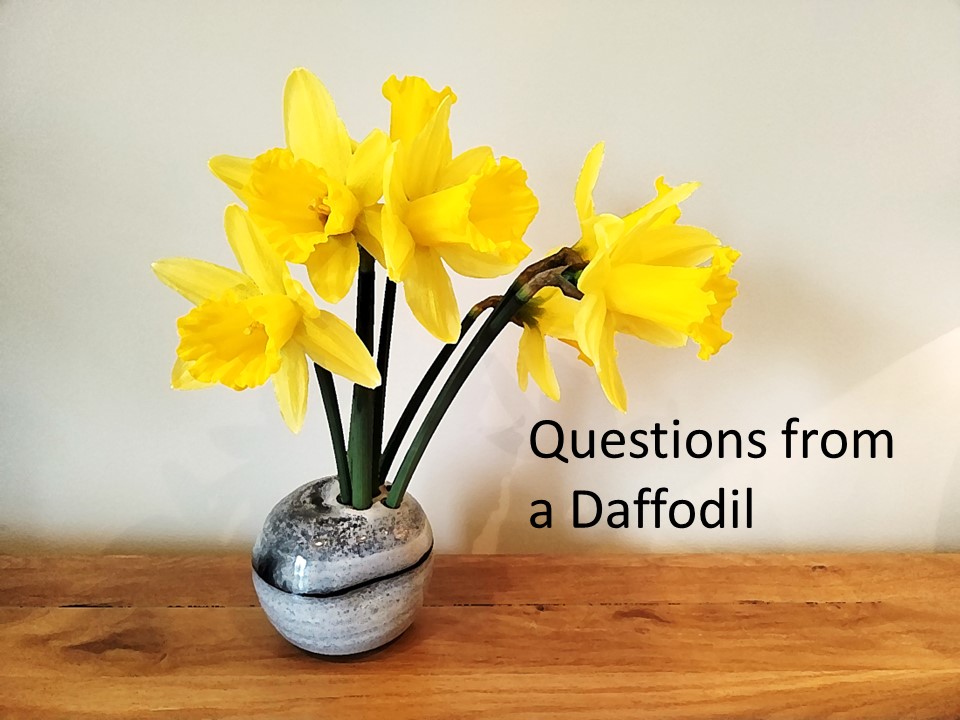
We like to ask questions of what we see – What? Why? How? That is the way our minds work. However, what if we allow the humble daffodil to draw questions out of us?! Interrogation and cross-examination tend to be the stuff of courts of justice and spy thrillers so what questions might the humble daffodil have to ask? Its very existence calls us to explain, ‘Why’? That shape, that colour, that timing in the seasons, it’s place in the ecosystem and how can it grow out of a mere bulb? Will we turn to scientists and botanists for answers, to poets and prose or choose to walk by and park the questions?
- ‘Science is fun. Science is curiosity. We all have natural curiosity. Science is a process of investigating. It’s posing questions and coming up with a method. It’s delving in’ – Sally Ride
- ‘No one is dumb who is curious. The people who don’t ask questions remain clueless throughout their lives’ – Neil deGrasse Tyson
- ‘Judge a man by his questions rather than his answers’ – Voltaire
- ‘Did I offer peace today? Did I bring a smile to someone’s face? Did I say words of healing? Did I let go of my anger and resentment? Did I forgive? Did I love? These are the real questions. I must trust that the little bit of love that I sow now will bear many fruits, here in this world and the life to come’ – Henri Nouwen
Turning to scientists for answers and they point us to genetics and facts. Genes in daffodils are located within the nucleus of the cell. They are arranged in lines along the chromosomes, which are condensed structures made of DNA (deoxyribonucleic acid) and proteins. Here are clues to provide insights into their growth, development, and adaptation to different environments. Whilst there are 36 species of daffodil, world-famous Kew Gardens advise that there are over 13,000 varieties. It is a member of the Amaryllidaceae family which also contains Agapanthus, Alliums, like onions and garlic, and Galanthus, like snowdrops. The scientific name of the daffodil genus, Narcissus, is linked to the Greek myth of Narcissus who fell in love with his reflection in a pool of water. Rather poetically, the nodding head of the daffodil is said to symbolise Narcissus gazing at his reflection. However, beware as all species of daffodil are poisonous to humans — the leaves, bulb and stem contain the highly toxic chemical lycorine. Information yes, but no answers.
Now to poet William Wordworth who was so inspired by daffodils. Writing his famous poem, he declared that daffodils dance in thousands ‘tossing their heads’ and ‘fluttering and dancing in the breeze’ but he gave no answers! Neither scientist nor poet provide adequate answers to the ‘Why?’ and ‘How?’ of daffodils. Yes, they can speak of genes but what of genesis? God spoke code such that it contained life that you and I share with daffodils.
- ‘Then God said, “Let the land produce vegetation: seed-bearing plants and trees on the land that bear fruit with seed in it, according to their various kinds.” And it was so’ – Genesis 1:11
- ‘But ask the animals what they think—let them teach you; let the birds tell you what’s going on. Put your ear to the earth—learn the basics. Listen—the fish in the ocean will tell you their stories. Isn’t it clear that they all know and agree that God is sovereign, that he holds all things in his hand— Every living soul, yes, every breathing creature? Isn’t this all just common sense, as common as the sense of taste?’ – Job 12:10 (TM)
- ‘You alone are the Lord. You made the heavens, even the highest heavens, and all their starry host, the earth and all that is on it, the seas and all that is in them. You give life to everything, and the multitudes of heaven worship you’ – Nehemiah 9:6
- ‘For since the creation of the world God’s invisible qualities—his eternal power and divine nature—have been clearly seen, being understood from what has been made, so that people are without excuse’ – Romans 1:20
It seems we do not need to turn to the brutal interrogation methods often used in war for answers but just open our eyes. Let the flowers inspire you but don’t ignore their questions and their answers. God is at work in your genetics and your genesis and, if you ask him, in your resurrection.
Be further inspired by the great hymn from Carl Gustav Boberg (1859) and Stuart K Hine (1949), ‘O Lord my God’

For further reading and thought: https://connect4life.org.uk/c4l-boosters/exile/