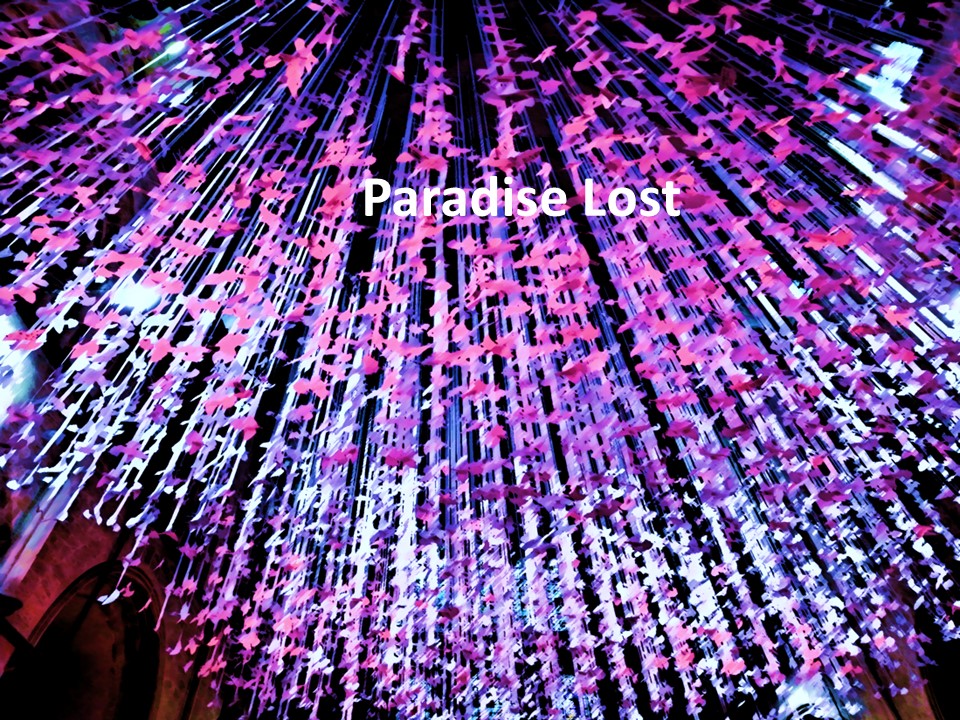
If you were born in the 1600s, you might have had a fair chance of understanding the 17th-century English poet John Milton – if not, there’s only a slim chance unless you studied English Literature at university! ‘Paradise Lost’ was his masterpiece containing over 10,000 lines of blank verse arranged into 12 books – it doesn’t rhyme, is full of ‘iambic pentameters’, dramatic imagery and complex old English words. Little wonder then that few people read it let alone comprehend it. A bit like this image, it is impenetrable unless you get a bit of context – Samuel Johnson declaring it to be a book that, ‘once put down, is very hard to pick up again!’ Be that as it may, most of us like the word ‘paradise’ as it conjures up some wonderful place or experience. It comes from an old Persian word ‘paridaida’ which the Greeks translated as ‘parádeisos’ meaning a walled garden. What comes to mind when you think of the concept – a place, a state of being or something you’d like that you’ve lost? In Book IX, there’s a reference to ‘a black mist low creeping’ as the problem facing mankind is revealed and then:
- ‘O unexpected stroke, worse than death! Must I thus leave thee, Paradise?’ – Paradise Lost, John Milton (Book XI, 268–270)
Perhaps the mist will lift with some more contemporary thinkers and language:
- ‘Ah, to think how thin the veil that lies between the pain of hell and Paradise’ – George William Russell’
- ‘Where choice begins, Paradise ends, innocence ends, for what is Paradise but the absence of any need to choose this action?’ – Arthur Miller
- ‘Hell is where everyone is doing his own thing. Paradise is where everyone is doing God’s thing’ – Thomas Howard
- ‘In the night, the stormy night, away she’d fly, and dream of para-para-paradise’ – Coldplay
Coldplay’s popular song is certainly catchy but it doesn’t seem the young girl ever gets much beyond her dreamy insight: ‘She said, “Oh, oh-oh-oh-oh, I know the sun must set to rise”’. Many other books and TV series have been written about paradise but it seems just as far out of reach. Milton’s epic poem was an attempt to look at the biblical story of the fall of mankind – in essence, Adam and Eve gave into the temptation from the fallen angel Satan to disobey God and so were their expelled from his presence in the Garden of Eden, hence Paradise Lost. It is part of the bigger story that reveals God’s grief in this and his greater plan to restore what was lost at huge personal cost.
Losing things is something we all dislike whether it be money, keys or friendships. It’s quite likely that you lost something like this recently and maybe there’s even a bit of ‘paradise lost’ that you long for? God’s good news that it can be regained is subtle and missed by many but consider how the offer is made, no matter how far away we may feel. It begins with Christmas and ends with Easter. Jesus came telling stories about someone who lost a coin, a farmer who lost a sheep and a father who lost a son. What was he talking about and how does he fit in to ‘Paradise Lost’? He comes to seek and save anyone who is lost for he is the Good Shepherd, he is the Father pining for his son – he knows what it is to lose something precious. To regain this loss, he gave his life on the cross – his gift to settle the price of our disobedience. Now that is love and no one is beyond his reach.
- ‘Suppose one of you has a hundred sheep and loses one of them. Doesn’t he leave the ninety-nine in the open country and go after the lost sheep until he finds it? And when he finds it, he joyfully puts it on his shoulders and goes home. Then he calls his friends and neighbours together and says, “Rejoice with me; I have found my lost sheep.” I tell you that in the same way there will be more rejoicing in heaven over one sinner who repents than over ninety-nine righteous persons who do not need to repent’ – Luke 15:4-7
- ‘Isn’t it right to join in the celebration and be happy? This is your brother we’re talking about. He was dead and is alive again; he was lost and is found again” – Luke 15:32
- ‘Greater love has no one than this: to lay down one’s life for one’s friends’ – John 15:13
- ‘Then he said, “Jesus, remember me when you come into your kingdom.” Jesus answered him, “Truly I tell you, today you will be with me in Paradise” – Luke 23:42-44
Thankfully this dying thief made the right decision – he cut it pretty fine but Paradise was restored! John Milton wrote of God pursuing lost ones with goodness and love that they might find ‘a paradise within thee, happier far’. Milton’s subsequent epic entitled ‘Paradise Regained’ explores the work of Christ – it was only 2065 line arranged in 4 books and far simpler! This intimacy we lost with God truly can be regained – ‘Paradise Lost’ can become ‘Paradise Restored’. If in doubt, see this link: https://connect4life.org.uk/wp-content/uploads/2023/06/unconnected2016.pdf

Some beautiful music composed by Gabriel Fauré c.1890 may help you reflect on this. It has often been sung at funerals but contains this prayer: ‘In paradisum deducant angeli’ (‘May the angels lead you into Paradise’)
In Paradisum:

When Jacob was on the run, he had a dream of a stairway leading to heaven from earth with angels going up and down. Waking, he heard God declare: ‘”I am with you and will watch over you wherever you go and I will bring you back to this land. I will not leave you until I have done what I have promised you”’ (Genesis 28:15). The picture shows paper cut-outs of doves representing angels carrying prayers to heaven. Why not pray that God will restore Paradise to you too?