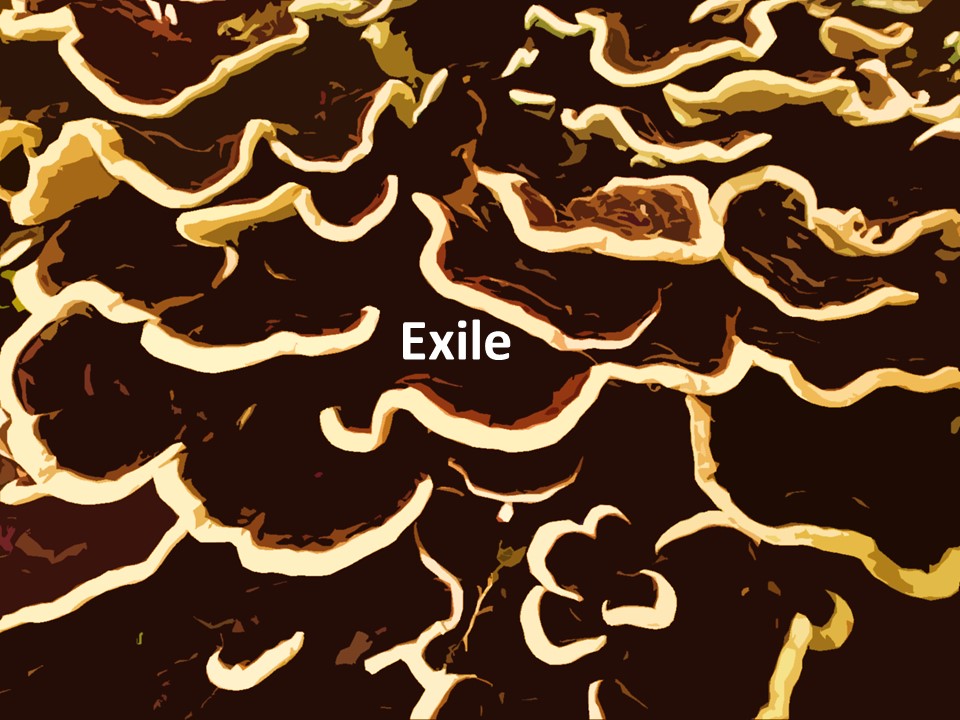
At its simplest, life is one entry and one exit! Whether or not the exit leads to a permanent exile depends on whether there has been a second entry – some will understand this but it will be explained later for anyone who is puzzled by it. Exile can be understood in various ways but essentially it means to be thrown out, ejected, banished or disconnected. You may have immediately recognised the subject of the photo but probably not! As a nation, the Israelites suffered exile twice as well as occupation by the Romans and captivity in Egypt – it’s not easy to think of another nation having had it so hard especially when you add in the many persecutions, pogroms and holocaust. Do you recall how when they escaped as a whole nation from Egypt that they were provided with food from heaven, ‘manna’? Nobody alive has seen it – like the photo, it puzzled people then and it does now, but some think it was like fungi or mushrooms. Appropriately, the word ‘manna’ sounds like the Hebrew word for ‘what is it?’. It was a supernatural provision for people in crisis. Have you ever felt in exile – excluded from a friendship group, from your family, from church or from God? It is very awkward and hurtful to feel like an outsider, ignored or overlooked.
- ‘Exile is like death. You cannot understand it until it happens to you’ – Golshifteh Farahani
- ‘If you don’t belong somewhere, that outsider status you have gives you perspective. Of course, another word for outsider is exile, and that’s not fun at all’ – Peter Morgan
- ‘You may succeed in silencing me, but that silence comes at a price, you may succeed in silencing one man, but the howl of protest from around the world will reverberate’ – Alexander Litvinenko
- ‘The Christian experiences and lives a paradox. He possesses joy in sorrow, fulfilment in exile, light in darkness, peace in turmoil, consolation in dryness, contentment in pain and hope in desolation’ – Mother Angelica
Whether for a nation, for a group or for an individual, exile is never a first choice but can be expedient for safety! History can tell of many who lived in exile – royalty such as King Charles 2nd and Mary Queen of Scots, Dante, Victor Hugo, Ernest Hemmingway, Oscar Wilde, Sigmund Freud, the Dalai Lama, Benazir Bhuto and Edward Snowden to name just a few. People may choose to be exiles to flee religious persecution such as the Huguenots, to escape extremist regimes, to avoid tax payments or like the many migrants choosing elsewhere for a perceived better life. Some of the many who have been displaced yearn for their homeland whereas others choose to make a new life for themselves. Renouncing German citizenship when he was 16, Albert Einstein described himself as ‘a wanderer on the face of the earth’ – he escaped from the Nazis, met Churchill, married his first cousin and had an affair with an alleged Russian Spy! A colourful character needing protection from those who wanted to kill him, he finally settled in America. Sometimes, regimes catch up with those who have fled – Alexander Litvinenko was poisoned in a London hotel by drinking a cup of tea and Georgi Markov was poisoned with the tip of an umbrella as recently as 2020. How hard it is for restless humans to live in peace – does an exile ever find peace?
- ‘The Lord God made garments of skin for Adam and his wife and clothed them. And the Lord God said, “The man has now become like one of us, knowing good and evil. He must not be allowed to reach out his hand and take also from the tree of life and eat, and live forever.” So the Lord God banished him from the Garden of Eden to work the ground from which he had been taken. After he drove the man out, he placed on the east side of the Garden of Eden cherubim and a flaming sword flashing back and forth to guard the way to the tree of life’ – Genesis 3:21-24
- ‘The people of Israel called the bread manna. It was white like coriander seed and tasted like wafers made with honey’ – Exodus 16:31
- ‘When he (the lost son) came to his senses, he said, “How many of my father’s hired servants have food to spare, and here I am starving to death! I will set out and go back to my father and say to him: Father, I have sinned against heaven and against you. I am no longer worthy to be called your son; make me like one of your hired servants.”’ So he got up and went to his father. But while he was still a long way off, his father saw him and was filled with compassion for him; he ran to his son, threw his arms around him and kissed him’ – Luke 15:17-20
- ‘But now in Christ Jesus you who once were far away have been brought near by the blood of Christ. For he himself is our peace, who has made the two groups one and has destroyed the barrier, the dividing wall of hostility … He came and preached peace to you who were far away and peace to those who were near’ – Ephesians 2:13-17
Adam was banished for disobedience and the Prodigal Son chose exile – they both felt the pain of separation and being unable to enjoy the presence of God the Father. In a way, those who either choose not to believe in God (Atheists) or who are unwilling to trust him (Agnostics) are both in a similar place of self-imposed exile. The Apostle Paul says in Romans chapter 8 that ‘the whole creation has been groaning’ with this burden for, as Saint Augustine declared, our souls are restless until they find rest in relationship with God. A man called Nicodemus was puzzled by the idea of not just a second chance but a ‘second birth’. Jesus explained it to him in John chapter 3 which is well worth a read to remind you of the route to peace with God, to escape from exile and to be back in his presence. God cares for the exiles – let the clothing given to Adam, the manna given to the Israelites, the father running to his son and the humble mushroom remind you of this next time you see one.